• Share on X
  • Share on Reddit
  • Share on LinkedIn
  • Share on WhatsApp
  • Partners Pricing
  • Partner PortalCustomer Sign in
  • Menu

    Close
    • Google Workspace Backup
    • Microsoft 365 Backup
    • K8s Backup & Management
    • AWS Backup
    • Azure Backup
    • Platform Overview
    • Pricing
    • Partners
    • About Afi
    • Support
    • Blog
    Sign in
  • Platform

    Overview of Afi technology and next-generation architecture

DATA PROTECTION

  • — Google Workspace

  • — Microsoft 365

  • — Kubernetes

  • — Amazon Web Services

  • — Microsoft Azure

From the blog

  • Google Workspace Backup Solutions Review
  • Microsoft Teams Backup: Options & Key Features
  • Can Ransomware Hit Your Microsoft 365 Data?
  • Security & Legal

About Us

Learn more and get in touch with us
  • More Details

  • Leadership Statement
  • Resource Library
  • Agreements

  • Privacy Policy
  • Terms of Service
  • Support ticket

    Submit a new support ticket or check the resolution of an existing ticket

  • Documentation

    Review product documentation in Afi Knowledge Base

Intro

Top Microsoft 365 Backup Vendors & Market Size

August 25, 2026
~14 min read•~2,900 words

At a Glance

  • Microsoft 365 backup market size is estimated at $1.9bn in 2026, with ~17% underlying CAGR.
  • Data-protection generalists account for ~58% of the market, SaaS-focused vendors for ~22%, MSP-focused providers for ~20%.
  • In our view, Veeam and AvePoint, as well as Afi (ourselves) are the top M365 backup vendors.

At Afi, we develop an M365 backup service, and as part of our competitive reviews we analyze the relative scale and growth momentum of our competitors. Most vendors publicly disclose only pieces of the puzzle: some report protected-user milestones, while others report broader product-suite ARR, company-wide subscription ARR, or customer count.

Our analysis combines public disclosures with partner and customer feedback, our knowledge of M365 backup pricing and channel mechanics, and other information gathered through informal discussions.

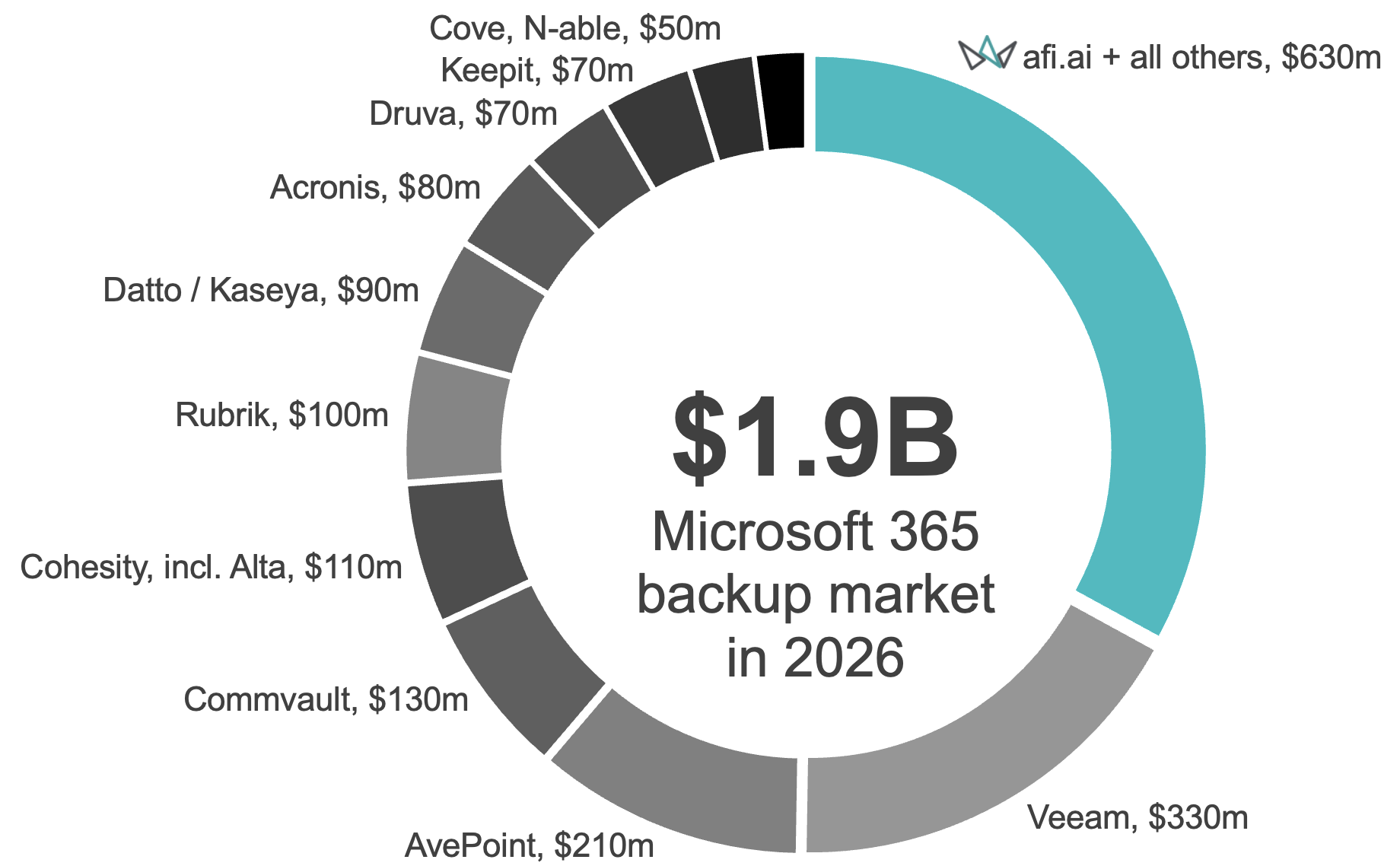
Microsoft 365 backup market size is estimated at $1.9bn in 2026; top vendors account for over 2/3 of all revenue.

Top M365 Backup Vendor Market Shares and M365 Backup Market Size

Using information available through August 12, 2026, and a measurement date of June 30, 2026, we estimate that the top vendors collectively generate ~$1.3bn of Microsoft 365 backup ARR, growing at 17% normalized CAGR.

The vendors fall into three groups:

  1. Data-protection generalists (e.g. Veeam, Commvault) sell M365 backup as one workload within a broader backup platform. Most of their revenue is generated from infrastructure workloads (VMs/servers, DBs).
  2. SaaS specialists (e.g. Afi, AvePoint) focus on M365 and SaaS apps. M365 accounts for >2/3 of their addressable market, and they are likely to offer granular coverage of M365, investing R&D resources to support M365.
  3. MSP-focused vendors (e.g. Kaseya, N-able) target SMB market through resellers (MSPs). Their backup products focus on multi-tenancy, billing tools, and other reseller-centric capabilities.
 1 

Top players

To summarize performance, we rank vendors based on scale and momentum (NTM growth × revenue), as we believe this provides a useful view of the competitive landscape.

Notably, the market performance is closely aligned with vendors' product capabilities (reviewed separately, see the blog post here). With few exceptions, vendors with stronger products have greater market share and stronger momentum.

Below, we discuss the market positions of the top three vendors, followed by a more detailed review of our revenue estimates and descriptions of other backup vendors in the next chapter.

Top vendors generate $8.8bn in total backup revenue, with M365 backup accounting for $1.3bn (15% of total).

RankVendorM365 backupM365ARRMomentumGrowthNTM growthTotal backupBackupvendor revenueM365 % oftotal revenueVendor type
1Veeam$330m12%$2.0bn17%Generalist
2AvePoint$230m17%$290m79%SaaS specialist
3afi.ain/dn/dn/dn/dSaaS specialist
4Rubrik$160m25%$1.57bn10%Generalist
5Commvault$130m22%$1.25bn10%Generalist
6Cohesity$110m16%$2.0bn6%Generalist
7Keepit$70m28%$90m78%SaaS specialist
8Druva$70m17%$300m23%Generalist
9Kaseya / Datto$90m14%$600m15%MSP channel
10Acronis$70m17%$420m17%MSP channel
11Ninja / Dropsuite$40m25%$48m83%MSP channel
12N-able / Cove$50m22%$200m25%MSP channel
Selected vendors$1.3bn17%$8.8bn15%
Other$0.6bn-$6.3bn10%
Total market$1.9bn-$15.1bn12%

Total backup vendor revenue is the vendor’s backup-attributable annualized revenue; the measure excludes revenue from resale and OEM-ed solutions powered by other vendors. Growth momentum is the estimated next 12 months (NTM) underlying growth rate, normalized to exclude short-term effects from product migrations and pricing actions (e.g., VB-to-VDC migration), as well as M&A-related vendor displacement, and synergies. The $15.1bn total backup market is based on 6.3% growth applied to IDC’s 2025 market estimate of $14.2bn.

Veeam

Veeam started as a backup software vendor for VMware in 2008. It built a trusted brand around a simple, reliable VM backup product. It later expanded to Hyper-V and physical servers/endpoints, and it launched Microsoft 365 backup in 2016, earlier than most major backup vendors.

Until 2023, Veeam sold its M365 backup as self-hosted software, which helped create an ecosystem of service providers that used the software to provide hosted M365 backup services. In effect, Veeam built a broad SaaS distribution network without operating the service itself.

Veeam launched its own SaaS backup in 2023, following its acquisition of CT4 (one of Veeam's service providers). But by then Veeam's early entry, trusted brand and service provider channel had already made it the largest Microsoft 365 backup vendor. Since 2023, a significant share of Veeam's M365 growth has been driven by migrations to its direct SaaS offering, a shift that likely created friction with the very service providers that invested in hardware to help Veeam build its M365 business.

AvePoint

AvePoint built its early business around on-prem SharePoint, with its DocAve tool used for SharePoint migration and administration. As Microsoft moved to Office 365, AvePoint followed, launching cloud backup for SharePoint Online and Exchange Online in 2013.

The company raised roughly $300m in 2014-2019 to scale its business, adding compliance, records management and productivity features to its software. In 2021 it went public and by 2025 AvePoint's data protection revenue exceeded 50% of recurring revenue, making M365 backup the core businesses for the company.

Afi

Afi.ai's revenue is not itemized below. As a private company, we do not report revenue figures. However, Afi is one of the fastest growing vendors with outstanding customer loyalty and retention rates, and it ranks among the leading vendors.

Afi data protection platform is based on new tech developed in 2020-2025, rather than adapted from legacy on-premises backup software. Its architecture is built for SaaS workloads, with native AI capabilities, high performance at petabyte-scale, and no technical debt or legacy constraints. Afi growth is 100% driven by strong product emphasis, as opposed to aggressive sales & marketing; Afi is exclusively focused on Microsoft 365 and cloud workloads, offering unique product capabilities (instant tenant-wide content search, full-fidelity M365 backup, and advanced security available in all plans to all customers).

 2 

Datapoints, assumptions and calculations

Veeam
~$330m M365 backup ARR  ·  25.6m protected users at $13  ·  ~17% of company ARR
Assumptions & calculations
SegmentUsersARR / userM365 ARR
Veeam Data Cloudest.5.0m$21$105m
Software licences, non-VCSP13.0m$12$156m
Software licences, VCSP37% of base7.6m$9$68m
Total25.6m$13 blended~$330m

25.6m protected users at June 2026, rolled forward from the 25m disclosed in February 2026 at ~11% annualised growth. 5m Veeam Data Cloud M365 users include migrations off software licences, implying M365 is ~30% of VDC ARR.

Veeam disclosed 16m M365 customers (including 6m VCSP licenses) at the time they launched Veeam Data Cloud in Oct 2023. VDC reached $50m ARR by the end of 2024; at the same time Veeam had 21m in non-VDC Microsoft 365 backup users.

VDC reportedly exceeded $250m revenue runrate by the end of 2025, and Veeam disclosed 25m+ protected M365 users in February 2026.

The slowing growth in M365 protected users (~6% YoY in February 2026) suggests that the VDC growth is driven by product migration rather than net new customer acquisition.

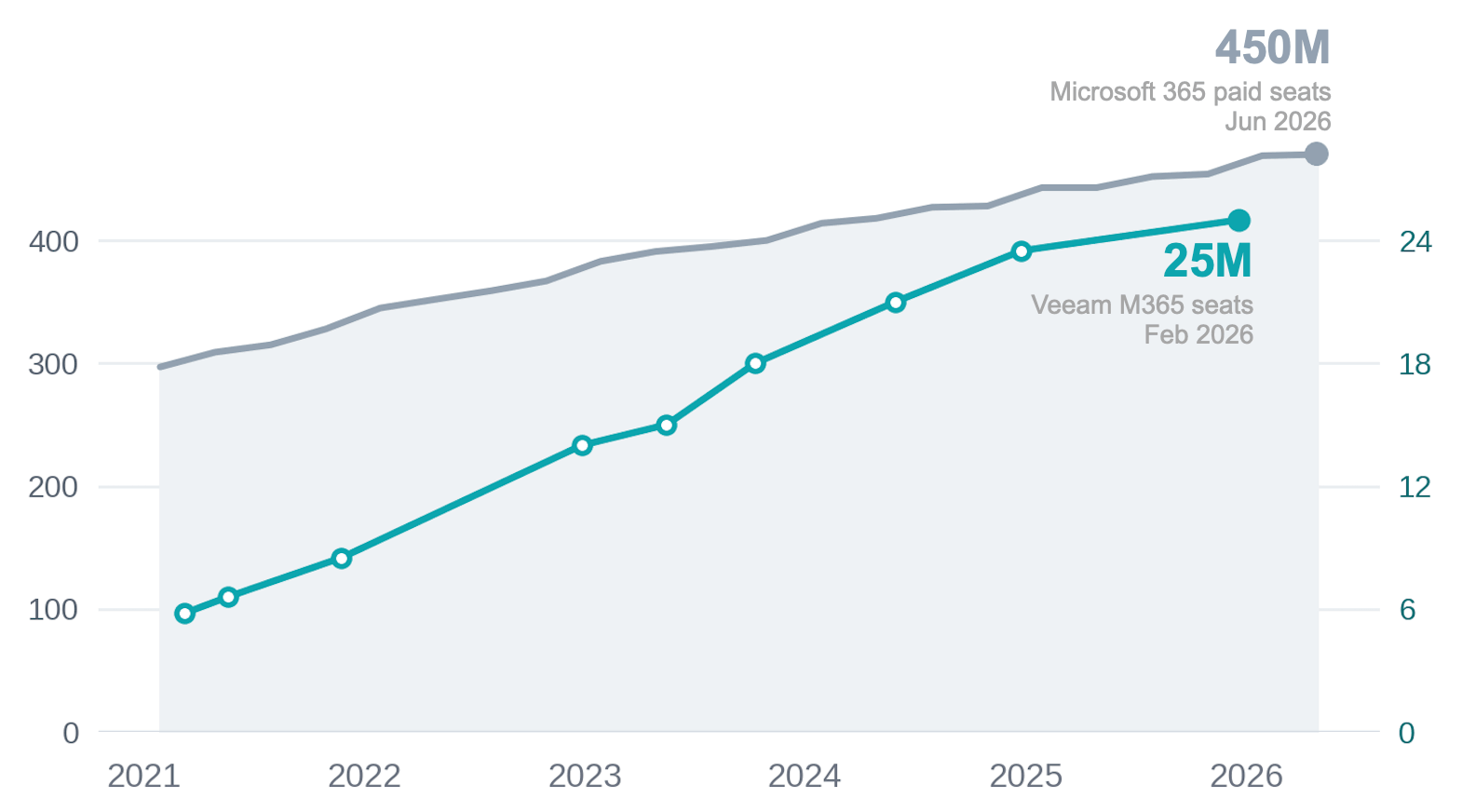
As the largest M365 backup vendor, the slow down in Veeam's growth is at least partly driven by the slow down in the M365 paid seats. Microsoft reported 6% YoY growth in paid M365 seats due to high penetration.

We believe that the 6% growth reflects a combination of VDC migration and changes in Veeam's channel model, as well as slower net new customer acquisition. As the VDC transition effects normalize, we would expect Veeam's M365 backup growth to reaccelerate. Over the longer term, given Veeam's high market share, its growth will increasingly converge toward growth in the underlying M365 paid seat base. As the largest M365 backup vendor, Veeam is already relatively penetrated, making M365 seat growth an important underlying driver.

Veeam's number of M365 seats grew 6% in Feb 2026, matching 6% growth in M365 seats reported by Microsoft.

Microsoft 365 paid seats and Veeam-protected Microsoft 365 seats, 2021 to 2026
Annualized seat growth 2021 2022 2023 2024 2025 2026
Veeam-protected M365 seats 93%Jul 2021 64%Jan 2022 58%Feb 2023 38%Dec 2023 22%Feb 2025 6%Feb 2026
Microsoft 365 paid seats 15%Mar 2021 16%Mar 2022 11%Mar 2023 8%Mar 2024 7%Mar 2025 6%Mar 2026

Veeam growth is annualized between consecutive protected-user disclosures; Microsoft growth is year over year at each fiscal Q3. Reporting dates differ and are shown under each figure.

AvePoint
~$230m M365 backup ARR  ·  ~50% of company ARR  ·  +27% company ARR growth
Assumptions & calculations
StepFactorRunning total
Company ARR, 30 Jun 2026disclosed—$465m
Resilience suite sharedisclosed Dec 2025×62%$288m
Core M365 backup shareestimate×79%~$230m

The balance of Resilience ARR is backup of other SaaS applications and adjacent capabilities.

AvePoint reported $465m of company ARR at June 30, 2026, up 27% year over year. Its Resilience product suite represented 62% of ARR at December 31, 2025.

Commvault
~$130m M365 backup ARR  ·  ~10% of total annualised revenue  ·  +38% SaaS ARR growth
Assumptions & calculations
StepFactorRunning total
SaaS ARR, 30 Jun 2026disclosed—$424m
M365 shareestimate×30%~$130m

Result is ~10% of Commvault's ~$1.25bn of Commvault annualized revenue. The remaining SaaS ARR includes Air Gap, IaaS, Salesforce and other cloud workloads that fall outside this measure.

On June 30, 2026 Commvault reported $424m of SaaS ARR growing at 38% year on year. In an earlier earnings call, management confirmed that M365 and Air Gap Protect continued to account for most of SaaS ARR.

Cohesity
~$110m M365 backup ARR  ·  5.5m protected users at $20  ·  ~5% of company ARR
Assumptions & calculations
SegmentUsersARR / userM365 ARR
DataProtect, pre-Veritas~30% ann. from Aug 20213.5m$20$70m
Alta SaaS Protection, ex-Veritasnet of post-M&A attrition2.0m$20$40m
Total5.5m$20~$110m

The DataProtect base is rolled forward from the 1m+ accounts disclosed in August 2021. Alta is held at 2m against the 2m M365 mailboxes reported before the merger, netting off attrition. Result is ~5% of Cohesity's ~$2bn total annualized revenue.

Cohesity said in August 2021 that it backed up more than one million M365 user accounts, with approximately 6 GB protected per user.

In December 2024 Cohesity acquired Veritas’ enterprise data-protection business, and the combined company reported $1.5bn of ARR. Veritas' Alta backup (which is in turn based on HubStor acquisition completed in 2021) was reported to protect over 2m M365 mailboxes and 69.8PB of data.

Cohesity continues to maintain its pre-Veritas DataProtect M365 backup product, as well as Alta SaaS Protection it acquired with Veritas. The company stated $2bn ARR as its medium-term target in Mar 2025, but has not disclosed topline numbers since, despite providing regular updates earlier.

Rubrik
$160m M365 backup ARR  ·  ~10% of subscription ARR
Assumptions & calculations
InputValueDescription
M365 backup ARR (incl. Entra ID)77% of SaaS and identity resilience ARR$154mAt the end of April 2026
M365 backup ARR~20% ANN.~160mAt the end of June 2026

M365 backup ARR is ~10% of the $1.57bn ARR reported at April 30, 2026. Total identity/SaaS backup revenue of $200m+ also covers Salesforce, Okta, and other SaaS workloads.

Rubrik reported $1.57bn of subscription ARR at April 30, 2026, up 32%. At June 2026 investor presentation Rubrik disclosed that M365 backup reached $100m ARR in 3.5 years after it was launched in fiscal 2H 2022; it also stated that it had $150m+ in total SaaS backup revenue (excludes Entra ID) and $50m+ in identity resiliency revenue (includes Entra ID and Okta data protection).

A February 2025 public-sector event page mentioned the company protected more than 2m M365 users.

Sophos Backup and Recovery Powered by Rubrik became generally available on June 1, 2026.

Kaseya / Datto
~$90m M365 backup ARR  ·  5.7m protected users at $16  ·  ~15% of data-protection ARR
Assumptions & calculations
InputValueBasis
Backupify+RMM revenue, yr to 30 Sep 2021$120mcombined SaaS backup and RMM sales
Implied Backupify revenue, yr to 30 Sep 2021$75m$120m less $45m Datto RMM (ex-CentraStage) revenue
Backupify M365 backup revenue, yr to 30 Sep 2021$36m$75m × 48% M365 share of total protected SaaS users

We ignore inconsistent statements regarding Datto SaaS / Backupify user base and estimate its M365 backup revenue based on Datto revenue disclosures, and our internal estimates consistent with Canalys' RMM/PSA market analysis.

SegmentUsersARR / userM365 ARR
Datto SaaS Protection, Backupify~12% ANN. FROM Sep 2021——~$60m
Spanning55% of 3m1.7m$17$29m
Total~$90m

Spanning M365 estimate is based on the 3m protected SaaS users disclosed by the company, and based on estimated 55% share of M365 backup (with the rest being mostly Google Workspace protected seats). Per-user ARR is based on actual prices after volume discounts, as well as bundled-product allocation. Result is ~15% of Kaseya's ~$600m of backup ARR (itself 47% of the total $1.5bn company ARR).

Kaseya owns two M365 backup vendors. First, Backupify (acquired by Datto in 2014; now marketed as Datto SaaS Protection) discloses 4.6m of users protected across its Microsoft 365 and Google Workspace products. Second, Spanning (acquired by Kaseya in 2018) mentions 24,000+ organizations, 2.5m+ users protected. Kaseya public statements also include contradicting statements and stale marketing materials, including a disclosure of just one million protected SaaS users in Aug 2026, at the same time mentioning 3.5m SaaS users on their landing webpage.

Both Spanning and Backupify remain separate economic products. Kaseya also sells Kaseya 365 User, a subscription bundle that includes Spanning/Backupify SaaS backup with email security and other tools.

Datto reported that it generated $120m in combined RMM and SaaS backup TTM sales in Sep 2021, before the merger with Kaseya.

Total Kaseya ARR is $1.5bn as of June 2026, ~flat year on year.

Acronis
~$70m M365 backup ARR  ·  ~21,000 MSPs at ~$3,300  ·  ~16% of company ARR
Assumptions & calculations
StepFactorRunning total
MSP partners disclosed—21,000
M365 backup ARR per MSPbenchmarked to Cove×$3,300~$70m

Acronis' direct online sales of M365 backup are de minimis, based on Semrush and other traffic trackers. ARR per MSP is benchmarked to ~15% below Cove ($3,800) and sits ~37% below Dropsuite's $5,250. The estimated M365 backup ARR is ~16% of Acronis' ~$420m ARR.

Acronis says Cyber Protect Cloud is used by 21,000+ MSPs and 750,000 businesses.

Implied Acronis' ARR is estimated at ~$420m in June 2026, consistent with Cohesity'sanalysis.

Keepit
~$70m M365 backup ARR  ·  8.7m protected users at ~$8  ·  78% of topline
Assumptions & calculations
InputValueBasis
FY2025 revenue, yr to 30 Sep 2025$62mDKK 416.0m, +41% year on year
Implied exit ARR, Sep 2025$72m2 × FY revenue less the average of FY2024 and FY2025
Backed up users, Sep 20259m5m at Dec 2024, scaled by customer count, 10,000 → 18,000
ARR per M365 user, Sep 2025~$8$72m ÷ 9m

ARR per user is low at ~$8, due to lower prices in OEM partnerships (Keepit powers ArcServe and HPE SaaS backup products), volume discounts, education licences.

StepFactorRunning total
Exit ARR, Sep 2025derived above—$72m
Growth to Jun 202635% annualised×1.25$90m
M365 share of toplineestimate×80%~$70m

Keepit used to develop Veritas' SaaS backup solution, which was marketed as Veritas SaaS Backup. In 2022 Veritas business was transferred to Keepit and it started to provide the services directly. In the year ended September 30, 2025 Keepit reported approximately $62m revenue, growing 41% year on year.

The company disclosed 5m protected users and 10,000+ companies in December 2024; by end of June 2026, Keepit materials referred to 25,000+ customers.

Druva
~$70m M365 backup ARR  ·  6.8m protected users at ~$10  ·  ~23% of estimated ARR
Assumptions & calculations
SegmentUsersARR / userM365 ARR
Direct M365 users~21% ann. from Mar 20255.3m$11$58m
Dell OEM usersdisclosed May 20261.5m$7$11m
Total6.8m$10 blended~$70m

The 3m+ users disclosed in April 2024 grew 33% to March 2025, then roll forward at ~21% annually. Per-user ARR reflects vendor discounting on large contracts and frontline-worker licences and the low OEM price. Result is ~23% of Druva's estimated ~$300m ARR.

Druva had passed $200m of total ARR and it had 4,000+ customers in August 2023.

In April 2024 it disclosed more than 3m protected M365 users across 5,000+ organizations. In a separate March 2025 publication it said active M365 users had increased 33% over the preceding year and that nearly half of its 7,500 customers used Druva for M365 workloads.

In May 2026 Druva announced that it had 1.49m protected M365 users as part of OEM deal with Dell

Cove / N-able
~$50m M365 backup ARR  ·  3.8m protected users at $13  ·  ~25% of N-able backup ARR
Assumptions & calculations
StepFactorRunning total
Protected M365 users, Q1 2026disclosed—3.5m
Growth to Jun 202620% annualised×1.053.7m
ARR per userestimate×$13~$50m

Per-user ARR is net of channel margin and volume economics. Result is ~25% of the $200m+ backup ARR disclosed on the Q2 2026 call, and ~$3,800 of M365 ARR per Cove MSP.

N-able reported 2.2m M365 users protected by Cove in September 2024, up 46% year over year, while the number of MSPs offering the service was 7,000, compared to 6,000 a year ago.

On Q1 2026 earnings call the company mentioned that the number of protected M365 backup users exceeded 3.5m. N-able also disclosed that its backup ARR exceeded $200m on Q2 2026 investor call.

The company has stayed at roughly 25,000 total MSPs across all products (stable for over 5 years) indicating that the growth in M365 backup usage is driven by increasing M365 penetration (~28% in 2024), rather than new MSPs.

NinjaOne / Dropsuite
~$40m M365 backup ARR  ·  ~$5,250 of M365 ARR per MSP  ·  ~8% of NinjaOne platform ARR
Assumptions & calculations
StepFactorRunning total
Dropsuite ARR, Dec 2024disclosed—A$49.8m
USD conversionUS$0.62 per A$×0.62$31m
M365 share of Dropsuite ARRestimate×85%$26m
Growth to Jun 202634% annualised×1.55~$40m

NinjaOne's non-Dropsuite M365 backup revenue is excluded from the estimate to avoid double-counting. Backup revenue from other backup solutions NinjaOne resells is included in respective vendors' estimates.

In December 2024, Dropsuite had A$49.8m of ARR and 1.65m paid users. Dropsuite also had approximately 5,000 MSP partners at the end of 2024, based on the >4,500 MSPs reported in June 2024, plus 270 new MSPs added in Q3 2024 and 169 added in Q4 2024.

NinjaOne acquired Dropsuite in 2025; by January 2026, NinjaOne’s overall platform had exceeded $500m of ARR.

 3 

Total market size & other vendors

We estimate that vendors whose individual revenue is not itemized generate an additional ~$600m of ARR, implying a total third-party M365 backup market of approximately $1.9bn, or 122m protected users.

The most significant vendors that are not itemized include ConnectWise, OpenText, and Redstor, which we estimate generate ~$80m of M365 backup ARR combined. The group also includes email security vendors (including Proofpoint and Barracuda), that offer backup as an additional service, as well as a long tail of smaller vendors (e.g. MSP360, HYCU) and regional providers.

Below, we discuss several of the more significant vendors included in Other category.

Connectwise / SkyKick

SkyKick was founded in 2011 as a developer of M365 migration tools. From the outset, it received strong endorsement from Microsoft and secured several large OEM relationships (incl. GoDaddy and Vodafone). The company raised ~$200m between 2011 and 2021.

Despite the strong start, SkyKick failed to scale its business and fell far short of AvePoint, its closest competitor. SkyKick reached only ~$45m of ARR by 2023, when it laid off ~50% of its workforce, and was subsequently acquired by ConnectWise (RMM/MSP vendor). ConnectWise integrated SkyKick’s technology into its portfolio, but killed the SkyKick brand and shut down its website.

OpenText / CloudAlly

Opentext/CloudAlly. CloudAlly used to be one of the early entrants in M365 backup. It launched its SaaS backup service in 2011 and reached $8m in ARR in 2020, when it was acquired by Zix (email-security vendor). In its turn, Zix was later acquired by OpenText (legacy software M&A platform) in 2021.

Aside from CloudAlly backup, OpenText also owns MicroFocus (legacy enterprise backup business spun off from HP) and Carbonite (cloud backup consolidator that combined Seagate legacy backup and EMC's SMB backup business). The resulting combination has ~$300m in backup revenue but very little focus on M365/SaaS workloads remains.

Top-down triangulation

We triangulate our M365 backup market estimates using top-down approach based on the number of paid M365 backup seats reported by Microsoft and estimated percentage of protected M365 users.

Microsoft helpfully reports M365 seats on a quarterly basis, and we use CoreView 2026 State of Microsoft 365 survey (registration required) to estimate what percentage of M365 seats are backed up. The CoreView report is especially helpful because it's a rare survey on the topic that is conducted by a non-backup vendor; it produces an estimate broadly consistent with our observations.

~$1.9bn Third-party M365 backup market  ·  122m protected users at ~$16
Assumptions & calculations
StepFactorRunning total
Paid Microsoft 365 seats, Jun 2026from MSFT disclosures—463m
Customers using a dedicated backup toolCoreView survey×35%162m
Within-tenant backup coverageAfi internal metrics×75%122m users
ARR per protected userobserved pricing×$16~$1.9bn

The 463m seat count is derived from the 450m disclosed in January 2026 and the ~6% annualised growth reported in June 2026. The CoreView sample is small at 279 respondents, but it is a rare estimate produced by a vendor with no backup product to sell. The remaining ~25% of users inside a protected tenant are typically left unprotected for cost reasons or because they do not require protection.


 4 

What the analysis includes

The revenue measure is annualized recurring revenue economically attributable to backup of Exchange Online, OneDrive, SharePoint, Teams and Entra ID. It includes self-managed software and backup-as-a-service products. For bundled platforms, we aim to allocate the portion of contract value attributable to Microsoft 365 backup, and exclude other workloads (endpoints, servers, DBs, Google Workspace and Salesforce) and product types (email security, archiving, e-discovery and compliance).

The revenue represents vendor-recognized gross revenue, rather than the amounts charged by resellers to the end customer. Values are in U.S. dollars.

The analysis covers third-party backup vendors and includes Microsoft’s backup revenue from Microsoft 365 Backup Storage API to the extent it is included in third-party vendors' topline (including Express, Microsoft editions).

 5 

Excluded vendors

There are a number of notable companies that we track closely but exclude from the market share analysis above for reasons we would like to mention here.

Synology

Synology is a ~$1bn-revenue, very profitable storage vendor and a significant Microsoft 365 backup player. Synology's Active Backup solution protects ~15m M365 users (based on 18m+ reported SaaS seats, assuming ~85% are M365 and ~15% are Google Workspace).

If Synology charged separately for software licenses, its scale would put it on par with Veeam. But it does no such thing: Synology M365 backup is bundled for free with its storage appliances, so there is no direct M365 backup revenue stream. Accordingly, Synology is not included in the market share analysis above.

Legacy giants

Historically, Dell(EMC), IBM and HPE were major players in enterprise backup. EMC's NetWorker, Avamar and Data Domain, IBM's Storage Protect and HP's Data Protector were the leading backup products of the 1990s and 2000s.

As the market shifted toward cloud-native and SaaS workloads, the legacy franchises became less relevant. While we estimate that the three legacy vendors still generate more than $2bn of backup revenue combined, their Microsoft 365 backup revenue is not incremental to the M365 market. None of the vendors have their own SaaS backup technology:

  • Dell's offering is based on Druva tech,
  • IBM Storage Protect for Cloud is based on AvePoint,
  • HPE OEMs Keepit SaaS backup.

Revenues from these products are attributed to Druva, AvePoint and Keepit, respectively, and we exclude Dell, IBM and HPE as separate vendors from our Microsoft 365 market-share analysis.


All product names are trademarks or registered trademarks of their respective holders; use of them does not imply any affiliation with or endorsement by them.


Afi Provides Modern Microsoft 365 Backup

Download datasheet Start free trial now
Related stories

M365 Backup Solutions Comparison

SharePoint Online Backup Options

Ready to try Afi? It only takes 1 min.

Start free trial
© Afi
Security & Legal
Terms
Privacy